
[FIXED] Pesky P0133 DTC
- scarney
-
 Topic Author
- Offline
- Senior Member
-

- Posts: 47
- Thank you received: 5
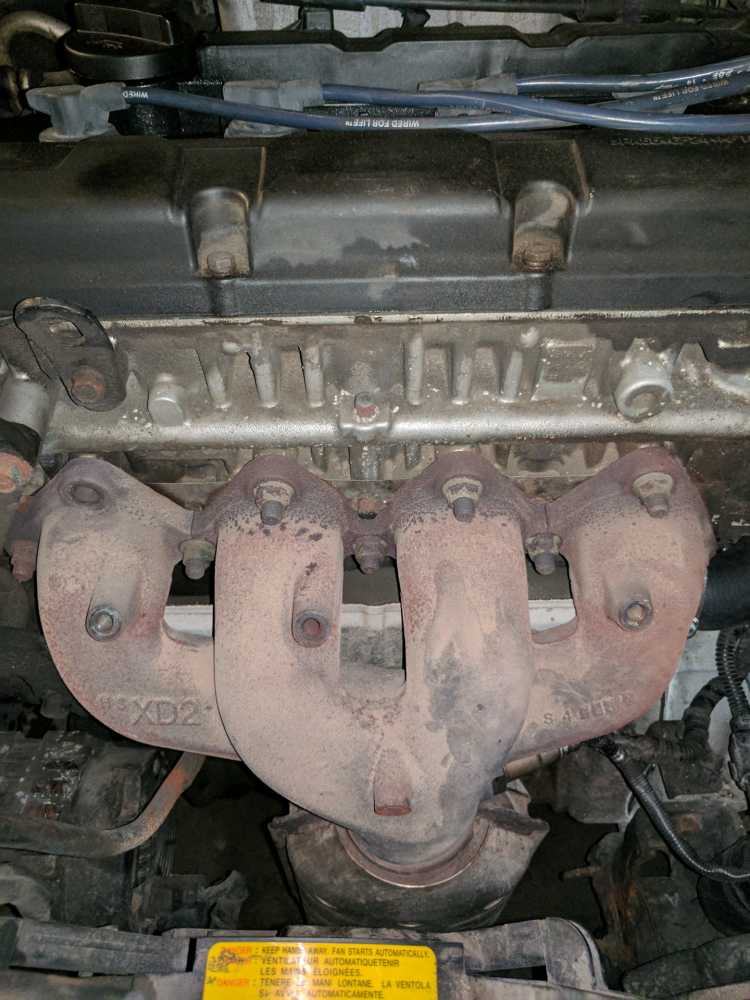
I am working on my mom's 2003 Hyundai Elantra GLS. The car throws a DTC of P0133 and has for some time. I have watched ScannerDanner's videos on his premium channel where he states that 99% of the time, the code indicates a faulty O2. However, after checking the car's service history, I see the O2 has been replaced twice. I initially believed the code to be cause by a leak in the exhaust manifold since I found there to be a stud missing(image attached). If you look closely you can see there are two vertical cracks around the second and fourth and lower nuts. It doesn't seem like there is a leak coming from there however. Anyways I put in a new stud, replaced the exhaust manifold gasket, and installed new nuts to 40 ft*lbs working from the center out. I completed two drive cycles and during the second drive cycle, the MIL illuminated halfway through as usual with the same DTC.
Here is some additional information you might find useful:
I did a few Google searches and it seems others have had this same issue, however, in those forums no one was able to provide any help to the owners. I did see a few people saying to pull the ECM fuse so the computer can reset after the repair, is there any difference between doing that and using my scan tool to clear the codes?
I have attached the Mode 6 data from my scan tool. This information is from before I replaced the exhaust manifold gasket. I can add the Mode 6 data from after the exhaust manifold replacement, as I believe there was a value that changed.
When I look at the O2 sensor data from B1S1, from my eyes it seems the sensor stays rich for just a bit longer than it stays lean. It dips down to lean and immediately bounces rich, however there is a slight delay before it goes lean again. I can take a screenshot of the trace, however it's easier to see in real time. I am using the Lemur BlueDriver scan tool.
The downstream catalytic converted was replaced about a month ago since the pipe had totally split at the flex pipe.
Any chance there is some electrical issue causing the code? Thanks in advance for the help and let me know if you need anymore information.
Steve
Please Log in or Create an account to join the conversation.
- Tyler
-
- Offline
- Moderator
-

- Full time HACK since 2012
- Posts: 6115
- Thank you received: 1539
 Not a misstep on your part, IMO.
There may be something to pulling the ECM fuse, or doing a soft reset. Engine computers can be funny about what they keep in memory, and this wouldn't be the first vehicle to have an emissions concern fixed with a battery disconnect. Nothing to lose by trying this!
While we're on the subject, how's the battery connections themselves? The O2 signal you're describing sounds like the signal tends to hover rich for too long, which could be explained by an excessive voltage drop across the O2 signal ground circuit. Block grounds and battery connections are highly suspect, in this case. This could be easily checked with a voltmeter.
I see that the downstream catalyst got replaced, but how about the downstream O2. I know you've got a code for the upstream sensor, but I have seen some vehicles that compare the two sensors to each other as part of the O2 monitor. A strangely behaving downstream sensor can actually fool the ECM into thinking there's something wrong with the upstream. I'd suggest watching both sensors during a test drive, make sure that the downstream swings full rich and lean. You can force both conditions by doing a WOT acceleration (rich), and during closed throttle deceration (lean).
Please Log in or Create an account to join the conversation.
- SniperDan
-
- Offline
- Senior Member
-
- Posts: 78
- Thank you received: 28
I was recently working on a Hyundai with a slow response O2 trouble code, and for the life of me could not duplicate the complaint. O2 switch rates seemed normal, and I could not find any exhaust leaks with the vehicle. I farted around with it for quite a while, trying to identify a leak both cold and hot, to no avail. So, I cleared the codes, and told the customer that if It returned we would throw an oxygen sensor in the vehicle. Well, sure enough, the vehicle comes back a month later with the same code in memory, so I put an oxygen sensor in.
Guess what came back 2 months later?
Yep. For the very same slow response code.
So I took another crack at it, finding no leaks, normal O2 switch rates, no real obvious problem. I went on a huge TSB hunt for any updated programming for the PCM pertaining to the code and found none. I was at a loss. It was at this point I came across a very tucked away hotline archive on Identifix about checking for exhaust leaks on this car, and what the guy was recommending was to physically block the exhaust with the engine running to cause a huge restriction, and then listen for exhaust leaks with a piece of hose.
Up to this point I had smoke tested the exhaust, used soapy water, used the hose method everywhere, pretty much every method I knew of to ID this leak . Trying his method out, I quickly found the leak, a cracked flexpipe. The car hasn't returned after repair, 4 months down the line.
This car whooped me a little bit, but maybe this may help you. Also, don't discount leaks downstream of the sensor. I have seen leaks upwards of 2 feet downstream still have an effect on O2 operation.
"Without data, you are just another person with an opinion."
~W. Edwards Deming
Please Log in or Create an account to join the conversation.
- scarney
-
Topic Author
- Offline
- Senior Member
-
- Posts: 47
- Thank you received: 5
I will take it step by step and today I'll trying pulling the ECM fuse. Any preference on whether or not the car needs to be warmed up before the fuse is pulled. I have seen people saying to warm up the car first, however no justification as to why is given.
I'll take a look at the batter connections when I head over there later today. I know how to use a Multimeter, however I am not familiar with check for block grounds with the tool. Can you explain what exactly I need to do or I'd be happy to watch a video instead if you know of any. I signed up for SD premium, so no problem if the video lives there.
Finally, I didn't replace the downstream O2 sensor when I replaced the downstream cat. She had the O2 sensor replaced twice, and actually neither time in the service records did it list which O2. I'm assuming she took the car to a parts changer who changed the upstream O2 when he saw the P0133 DTC. Therefore I believe the upstream O2 was replaced twice and the downstream O2 has never been replaced. When I replaced the downstream cat I did notice that the downstream O2 was hardly even screwed into the cat, I was able to unscrew it by hand. As far as the sensor voltage, it pretty much stays around .745 V, I have seen it dip lean once or twice. I think when it dipped lean it was during or right after a hard acceleration. Thanks for all the help.
Steve
Please Log in or Create an account to join the conversation.
- Tyler
-
- Offline
- Moderator
-
- Full time HACK since 2012
- Posts: 6115
- Thank you received: 1539
scarney wrote: I will take it step by step and today I'll trying pulling the ECM fuse. Any preference on whether or not the car needs to be warmed up before the fuse is pulled. I have seen people saying to warm up the car first, however no justification as to why is given.
Interesting :huh: I dunno that the temperature make a difference? I'd just pull the battery cables off and go have a cup of coffee. :lol:
I'll take a look at the batter connections when I head over there later today. I know how to use a Multimeter, however I am not familiar with check for block grounds with the tool. Can you explain what exactly I need to do or I'd be happy to watch a video instead if you know of any. I signed up for SD premium, so no problem if the video lives there.
No problem! Here's a couple videos covering main power and ground testing.
You're not going to find an issue as severe as the one seen in the Cadillac video, as this Hyundai starts and charges. But, the basic principle is the same. If your multimeter has a peak hold function, that'd be ideal. Connect it from the block to the battery negative post, and crank the engine. Less than 300mV would be OK to me.
Finally, I didn't replace the downstream O2 sensor when I replaced the downstream cat. She had the O2 sensor replaced twice, and actually neither time in the service records did it list which O2. I'm assuming she took the car to a parts changer who changed the upstream O2 when he saw the P0133 DTC. Therefore I believe the upstream O2 was replaced twice and the downstream O2 has never been replaced. When I replaced the downstream cat I did notice that the downstream O2 was hardly even screwed into the cat, I was able to unscrew it by hand. As far as the sensor voltage, it pretty much stays around .745 V, I have seen it dip lean once or twice. I think when it dipped lean it was during or right after a hard acceleration. Thanks for all the help
That sounds like good downstream O2 behavior to me! I admit, this is a far outside possibility, just something that came to mind while reading your thread.

Sniper Dan's suggestion to block off the exhaust is great, too. Maybe talk an assistant into jamming a rag into the exhaust while you listen to the exhaust?
Please Log in or Create an account to join the conversation.
- scarney
-
Topic Author
- Offline
- Senior Member
-
- Posts: 47
- Thank you received: 5
Steve
Please Log in or Create an account to join the conversation.