
1999 Nissan Altima GXE - Crank, no start
- OldVet
-
 Topic Author
- Offline
- New Member
-

- Posts: 4
- Thank you received: 0
* Fuses checked with multimeter in car and under hood
* no trouble codes
* Compression checked and have spark per above
* Fuel pump, fuel relay, fuel filter, fuel pressure all good
* Fuel injectors ohm out to expected value
* Fuel injector feed wires have expected +12v with ignition on
* Noid light does not come on when engine is cranked
At this point my thought was that it was most likely a computer issue. I did an ohm test between the ground control pin on the fuel injector connector and the car ground. While cranking the engine, the ohm test indicated that the ECM pulse was being sent to each fuel injector connector.
So why wouldn't the noid light work?? Something had to be happening to the +12v fuel injector feed when the engine is cranked. I did a voltage test during engine crank and found that the voltage dropped to a steady +9v reading. To me, this explains why the noid light didn't light up.
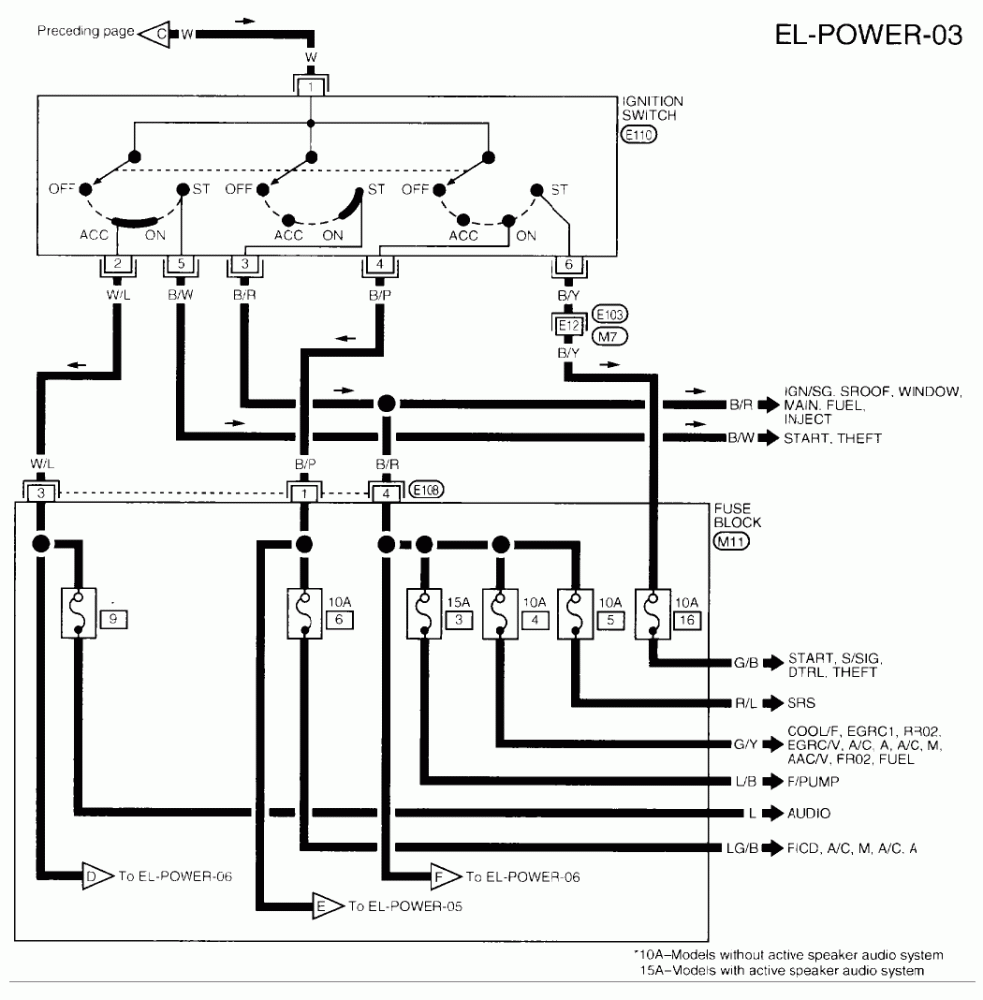
I also found that with the ignition off, I had -12v between the fuel injector feed wires and the positive 12v battery terminal. This indicates that when the ignition is switched off, the fuel injector feed wires short to ground. However, the ignition wiring diagram (see diagram at end) shows that the wire that feeds the +12v to the fuel injectors is simply disengaged from +12v positive, and not shorted to ground, in the off position.
My thinking at this point is that the ignition switch itself is the prime candidate for the culprit. I'm basing this on the fact that it shorts to ground in the off position and the voltage drops during crank. The short in the off position isn't 100%. Maybe that's why I just get partial voltage during crank.
I'm seeking advice or insight as to whether I should do additional troubleshooting steps or if you think the ignition switch is the culprit. This is my first post. While not an auto technician, I have attempted to perform every test I could think of before I posted. I also searched here and on Google to make sure I wasn't posting a question that had an easy answer. Please let me know if I haven't followed forum rules or if I left out pertinent information.
I'm in Pittsburgh, PA and I have reviewed the Scannerdanner videos on YouTube. I'm very appreciative that he uses simple tools like multimeters to diagnose issues. I didn't realize that he had a forum as well. I posted this on another site, but wouldn't have had I known. That won't happen again.
Thank you in advance for any insight you may have.
Please Log in or Create an account to join the conversation.
- Ben
-
- Offline
- Platinum Member
-

- Posts: 1098
- Thank you received: 215
Sent from my SM-N920P using Tapatalk
Please Log in or Create an account to join the conversation.
- borntoroll
-
- Offline
- Senior Member
-

- Posts: 74
- Thank you received: 9
What is this check? Did you measure voltage or resistance?I did an ohm test between the ground control pin on the fuel injector connector and the car ground. While cranking the engine, the ohm test indicated that the ECM pulse was being sent to each fuel injector connector.
Please Log in or Create an account to join the conversation.
- Andy.MacFadyen
-
- Offline
- Moderator
-

- Posts: 3357
- Thank you received: 1037
The reason why the injector +12 feed wire appears to drop to groumd is that other loads will be fed from the same supply.
I would also agree 12 volts dropping to 9 volts sounds like a battery in need of charge. A fully charged battery should read 12.5 to 12.8 volts and drop to no less than 10.1 volts or so when cranking.
" We're trying to plug a hole in the universe, what are you doing ?. "
(Walter Bishop Fringe TV show)
Please Log in or Create an account to join the conversation.
- borntoroll
-
- Offline
- Senior Member
-
- Posts: 74
- Thank you received: 9
Did you have anything connected to DLC while measuring? And injectors connected or disconnected all together? And can you light a testlight between fuel injector feed and batt positive?OldVet wrote:
I also found that with the ignition off, I had -12v between the fuel injector feed wires and the positive 12v battery terminal.
Please Log in or Create an account to join the conversation.
- OldVet
-
Topic Author
- Offline
- New Member
-
- Posts: 4
- Thank you received: 0
The noid lights are incandescent. I pulled the battery to charge. It's on a Schumaker SSC-1500A at 15A. I have had great success with this charger in the past. It took me a week, but I brought my son's Powerwheels battery back to life! Thank you!
Borntoroll,
(Q#1) I did an ohm (resistance) test between the car ground and the fuel injector ground control pins. While cranking the engine, the meter pulsed indicating a signal was being sent from the ECM. Please let me know if you need more info. Thank you!
Andy.MacFadyen,
Battery on charge as noted above. Thank you!
I appreciate the kind words in regard to the tests performed.
Borntoroll,
(Q#2) TIL a DLC is a Diagnostic Link Connector! Gaining knowledge already! No, I did not have anything connected to DLC while measuring. All injectors were disconnected from the wire harness while performing the tests I noted.
Yes, I was able to light a test light between the +12v feed wire on each fuel injector connector and battery positive. This was done while the ignition was off (key removed) and all connectors were removed from the fuel injectors.
I appreciate all the responses! THANK YOU! I will check and reinstall the battery on Monday. I will respond and keep up to date with any posts over the weekend.
Please Log in or Create an account to join the conversation.
- borntoroll
-
- Offline
- Senior Member
-
- Posts: 74
- Thank you received: 9
Do you still have ground at injector feed if you remove fuse 21?
Please Log in or Create an account to join the conversation.
- ScannerDanner
-

- Offline
- Administrator
-

- Religion says do, Jesus says done!
- Posts: 975
- Thank you received: 500
Disconnect one injector, test light to battery positive and touch on control wire during cranking. Does it pulse the test light? If it does not. Forget about the low voltage you are seeing on the supply. If it does pulse the test light,
It absolutely could be a supply side issue. The voltmeter is not going to be the tool to use here because of how fast the injectors fire and you may have a larger drop in the feed than what you are seeing with the voltmeter. The alternate fuel source is allowing the engine to start and charging voltage is providing enough increase in voltage to overcome the drop allowing the injectors to fire.
Maybe a better test, backprobed the feed wire, test light to ground (incandescent), crank it, what does test light do?
Don't be a parts changer!
Please Log in or Create an account to join the conversation.