
2017 Ford Transit 3.7L - Accelerator Pedal Sensor DTC P2122
- Mgh
-
 Topic Author
- Offline
- New Member
-

- Posts: 6
- Thank you received: 0
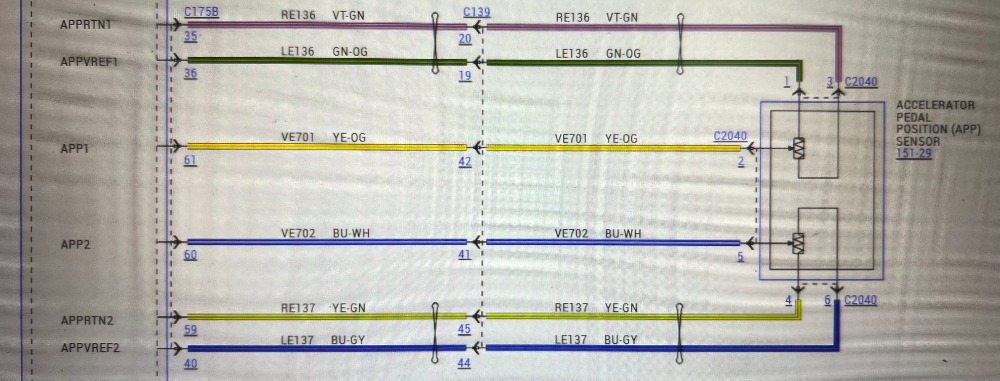
DTC P2122. Actual problem: reading battery voltage at one of the 2 sensors' ref wires.
Sensor 2:
APPVREF2 -> 5v when the car is running.
APPRTN2 -> tests fine when measured with the positive lead connected to power.
APP2 -> Signal reading changes when pushing the pedal
Sensor 1:
APPVREF1 -> 12v or ~14 when the car is running.
APPRTN1 -> tests fine
APP1 -> No signal when pushing the pedal
DTC is related to Sensor 1.
The above readings are consistent whether the connector at the pedal is plugged/unplugged.
I inspected the wires, everything looks clean, no corrosion from end to end. There is an intermediate connector, which I unplugged and inspected, looks good.I swapped 5v ref wires, the DTC went to Sensor 2, and the signal was working as I pressed on the pedal in sensor 1.There was a PCM lying around that I swapped, same battery voltage at the ref.
If disconnect the PCM, the battery voltage and 5v ref disappear. Same when I disconnect the connector, which I think supplies grounds and powers.Looks like I have short to power, and to me, everything is pointing to the PCM; but what are the chances of the other PCM having the same issue?
Any help would be appreciated, thank you!
- Val
Please Log in or Create an account to join the conversation.
- Noah
-

- Offline
- Moderator
-

- Posts: 5096
- Thank you received: 1135
Near battery voltage on the APP 1 5v ref feed. I checked the PCM power and grounds and cut the APP 1 5v reference wire about 6" from the PCM, and still had high voltage coming from the PCM. In my case, that pointed away from a short to voltage on that individual circuit, but I still kind of wonder if a short to voltage on another 5v ref circuit could back feed and cause a similar issue.
A new computer from Ford fixed mine.
Please Log in or Create an account to join the conversation.
- Mgh
-
Topic Author
- Offline
- New Member
-
- Posts: 6
- Thank you received: 0
Thank you for your reply!I just had a 2020 Transit connect with a very similar issue.
Near battery voltage on the APP 1 5v ref feed. I checked the PCM power and grounds and cut the APP 1 5v reference wire about 6" from the PCM, and still had high voltage coming from the PCM. In my case, that pointed away from a short to voltage on that individual circuit, but I still kind of wonder if a short to voltage on another 5v ref circuit could back feed and cause a similar issue.
A new computer from Ford fixed mine.
I had done the same. I cut the wire to eliminate any harness issues and still seeing that high voltage. I put that wire under load using a test light and it's very dim. Leaning more and more towards an internal backfeed / leakage inside the PCM, as it's not a real output.
I unplugged all sensors, that I know of, except the Fuel Tank Pressure. Will look into this further before condemning the PCM.
Please Log in or Create an account to join the conversation.
- Mgh
-
Topic Author
- Offline
- New Member
-
- Posts: 6
- Thank you received: 0
Thoughts?
Please Log in or Create an account to join the conversation.
- Noah
-
- Offline
- Moderator
-
- Posts: 5096
- Thank you received: 1135
Or a bad computer ground, but I'm pretty sure you said you load tested them.
Please Log in or Create an account to join the conversation.
- Noah
-
- Offline
- Moderator
-
- Posts: 5096
- Thank you received: 1135
Mine is a Transit Connect FWD 2.0, so not the same as yours exactly, but here is what I found.
This one is very intermittent, but it came with 5v ref codes, app codes and a few others relating to 5v sensors.
I couldn't get it to act up again, but I started investigating 5v ref sensors near 12v supplies.
The harness that has the vent valve also have the fuel tank pressure sensor harness along side it, and it was pinched to the floor by the heat shield on the fuel tank.
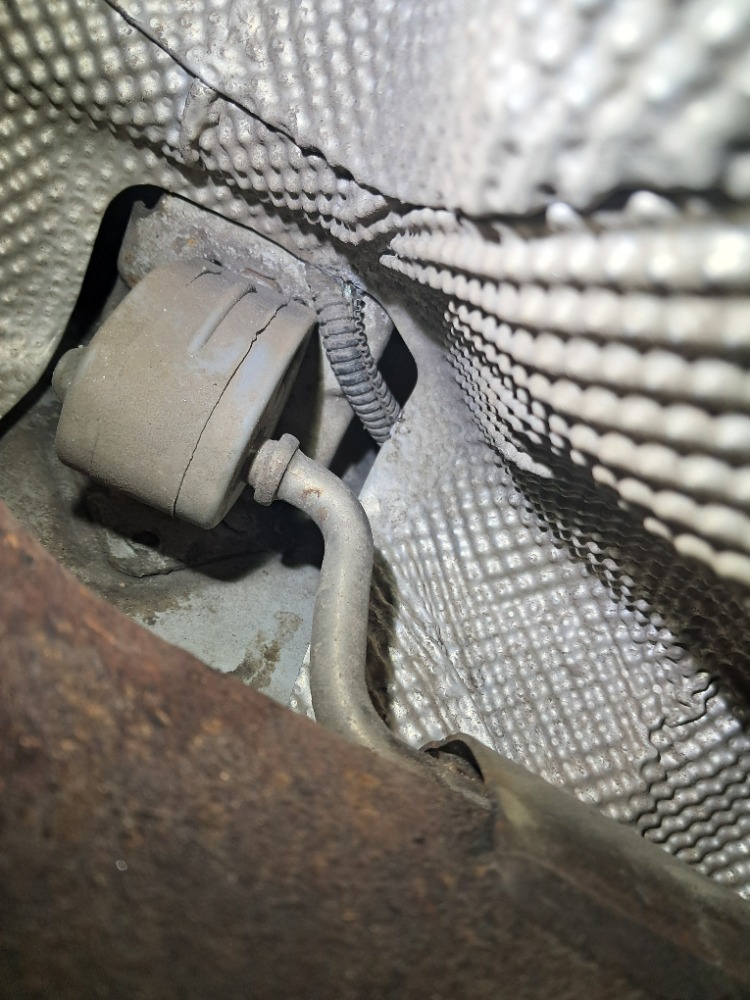
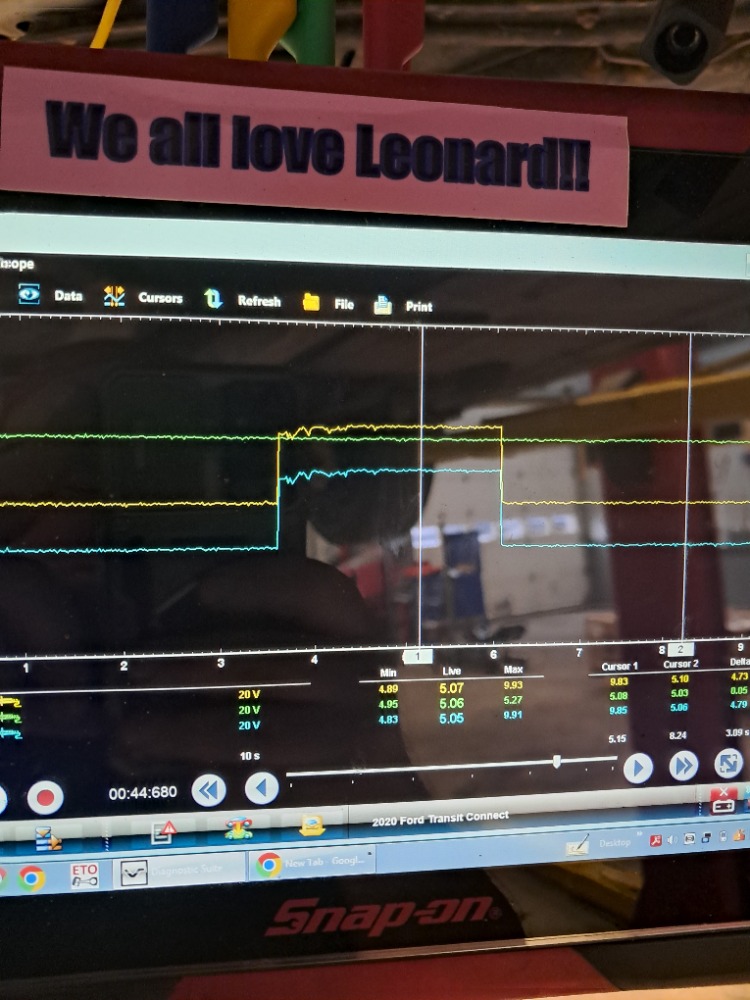
With my scope attached as follows:
Ch1 yellow app1 5v ref
Ch2 green battery current sensor 5v ref
Ch3 fuel tank pressure 5v ref
Manipulating the area where the harness is rubbed through, app1 5v ref goes to 9v and the 5v ref circuit code resets.
Please Log in or Create an account to join the conversation.
- Noah
-
- Offline
- Moderator
-
- Posts: 5096
- Thank you received: 1135
Please Log in or Create an account to join the conversation.
- Mgh
-
Topic Author
- Offline
- New Member
-
- Posts: 6
- Thank you received: 0
I disconnected all sensors I could find, including the vent valve, no success.
Went back and did some more digging and found the exact same issue on the A/C Pressure sensor. Same DTC description of low current, which started to make sense as that "battery voltage" is just phantom voltage. Test light is very dim.
According to the diagram, the vref is shared with the A/C pressure, Fuel Tank pressure sensor and the Alternator Current sensor. FTP has 5v, but not the A/C. The APP has a dedicated refv as you know, so kinda strange how they exhibit the same behavior while they're on different circuits.
Service data says to check these:
VPWR
SIGRTN
APPRTN2
APPRTN1
ETCRTN
VREF
APPVREF2
APPVREF1
ETCREF
My suspicion is the Alternator Current sensor, which I will check later. For now, I borrowed a refv from a different circuit and all is working fine. I also confirmed the PCM is working fine.
Will post back updates.
Please Log in or Create an account to join the conversation.
- Noah
-
- Offline
- Moderator
-
- Posts: 5096
- Thank you received: 1135
That's a good place to start, but if the short is in the harness, then disconnecting individual components will not remove the short. That's why I suggested removing the fuse for the vent valve. That won't remove the short, but it will remove the power from the fuse block all the way to the vent valve and, because it's low side driven, back to the PCM. If the voltage on app ref 1 changes, then you can isolate the short down to that section of harness.Sorry to jinx you lol. Thank for sharing the info and good find!
I disconnected all sensors I could find, including the vent valve, no success.
Again, if it a short in the harness, like the example I showed, the ref circuit may just barely be touching power. I wouldn't expect the Transit I saw to light a test light either unless the wires were severely damaged and melted together.Went back and did some more digging and found the exact same issue on the A/C Pressure sensor. Same DTC description of low current, which started to make sense as that "battery voltage" is just phantom voltage. Test light is very dim.
The individual ref circuits are not as isolated as your may think by looking at the diagram. It is entirely possible that due to the internal circuitry of the PCM that a short on one 5v ref circuit will effect a seemingly different sensor circuit. Like in my attached scope capture, the app 1 5v ref should be its own dedicated 5v ref circuit according to the diagram. We can see that by shorting the 5v ref for the fuel tank pressure sensor to voltage on the vent valve circuit power feed, that it must share some part of the circuit in the PCM, or it would remain uneffected. On the other hand, the green channel on the scope is connected to the battery current sensor 5v ref feed and is entirely uneffected by the short to power on the fuel tank pressure sensor circuit. Essentially what I'm getting at is, we down know exactly how the PCM is regulating the 5v reference and distributing it through out the van, regardless of what service information would have us believe.According to the diagram, the vref is shared with the A/C pressure, Fuel Tank pressure sensor and the Alternator Current sensor. FTP has 5v, but not the A/C. The APP has a dedicated refv as you know, so kinda strange how they exhibit the same behavior while they're on different circuits.
Service data says to check these:
VPWR
SIGRTN
APPRTN2
APPRTN1
ETCRTN
VREF
APPVREF2
APPVREF1
ETCREF
Let us know what you find, I'm interested to see how this plays out for you. Sounds like you're making good progress.My suspicion is the Alternator Current sensor, which I will check later. For now, I borrowed a refv from a different circuit and all is working fine. I also confirmed the PCM is working fine.
Will post back updates.
Please Log in or Create an account to join the conversation.
- Mgh
-
Topic Author
- Offline
- New Member
-
- Posts: 6
- Thank you received: 0
I removed the EVAP fuse, still getting battery voltage at the vref of both the APP1 and the A/C Pressure sensor.
I continued to remove all fuses and relays in the engine compartment, and unplugged the Alternator Current sensor, but to no avail.
I agree that we don’t really know how the PCM regulates voltage, because the A/C pressure sensor shares the same vref as the the Alternator current sensor, which works fine. There has to be some back feed from another sensor, but I think I should’ve gotten 5v when I removed all fuses and relays. I’d imagine voltage could probably leak internally, but I am 100% sure the PCM is functional, because I installed it in a different van and worked fine.
What I find interesting about this issue is that even when the ignition is off, APP1 and A/C sensor vref measure battery voltage. I know this could be fed through a constant B+, but again, as I mentioned before, there is almost no current, as the the test light is very dim; so I still doubt there is short to positive; otherwise, test light would be bright. I am leaning towards a back feed from some sensor or some splice.
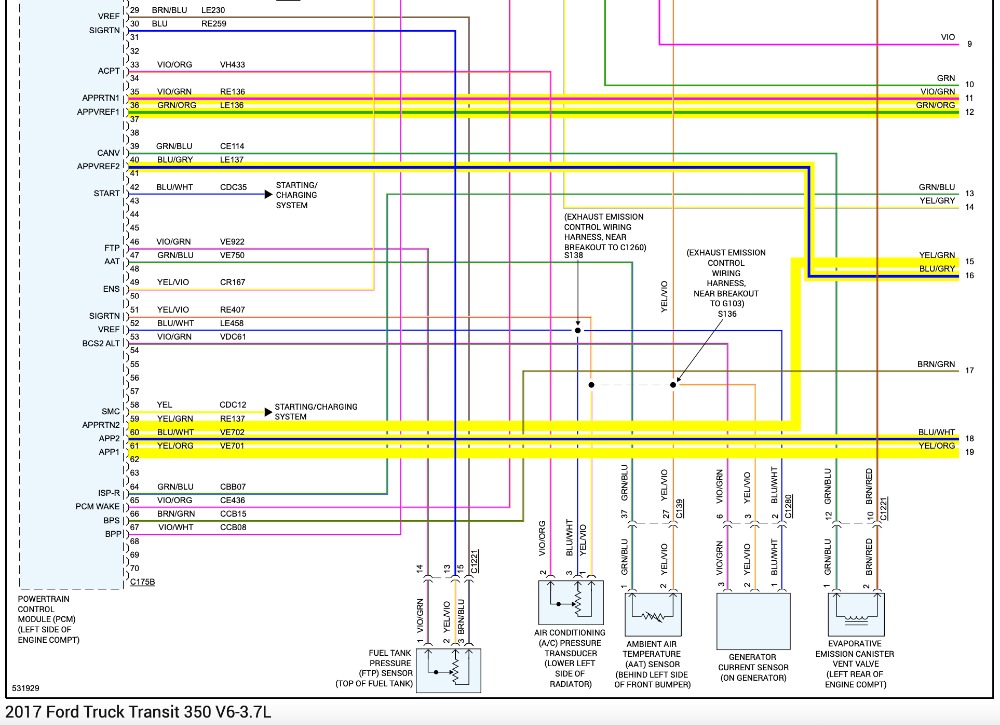
See attached part of the diagram, ignore highlighted lines. There is a note about that vref: (EXHAUST EMISSION CONTROL WIRING HARNESS, NEAR BREAKOUT TO C1260) S138
I will check there and post back.
Please Log in or Create an account to join the conversation.
- Mgh
-
Topic Author
- Offline
- New Member
-
- Posts: 6
- Thank you received: 0
Thank you for helping out!
Please Log in or Create an account to join the conversation.
- Noah
-
- Offline
- Moderator
-
- Posts: 5096
- Thank you received: 1135
Please Log in or Create an account to join the conversation.