
Help us help you. By posting the year, make, model and engine near the beginning of your help request, followed by the symptoms (no start, high idle, misfire etc.) Along with any prevalent Diagnostic Trouble Codes, aka DTCs, other forum members will be able to help you get to a solution more quickly and easily!
Brand new diesel car expected values
- cac
-
 Topic Author
- Offline
- New Member
-

Less
More
- Posts: 2
- Thank you received: 0
7 years 6 months ago #24461
by cac
Brand new diesel car expected values was created by cac
hi, I've bought brand new Fiat Tipo(Egea) Multijet 1.6 120hp diesel in the beginning of 2018. I drive about 3k km per month , I live in the country so no traffic, no traffic lights, mostly I drive 30+ km - perfect for diesel engine, so I expected fuel consumption at 5.0 - 5.5 l/100km. Since day one my car fuel consumption was 6.4 - no matter what - I could go 90km/h speed or 160km/h - every single tank (computer and myself calculations ) was 6.4. Another strange thing from beggining is FC high rise out of blue, for example: I drive on highway 120kmh , 6th gear, cruise control on (it happens whe off too)- it's about 2100 rpm and computer shows about 4,9 FC, suddenly it rises to 10 l/100. It happens every day several times and last 2-3 seconds, and from time to time it can last for even several minutes (thought it was DFP burnout, but it can occure several time a week even when driving in city).
After 5000km "check engine" lit. So I went to car dealer service and told them that car is acting strange and the icon lit. They said "too high voltage on throttle", replaced the throttle and deleted the error. If there is no more error codes service see no problem....
After that FC dropped just a little to 6.2-6.3 but still completly independent to speeding, ac usage, outside temperature etc.
After 14000km driven, FC dropped to 5.9-6.0 - just like that. I've bought OBD interface and some software to get readings and prove faults to car dealer service. And I've found some really strange values imho. My problem is that I cannot find any expected values over the internet, especially for diesel engines which vary from petrol one. For now my baseline is comparision to my friends diesel cars (renault clio and opel/vauxhall corsa) - it's not a perfect solution though.
So here is what I see and looks suspicious to me - maybe someone can confirm/decline my worries - please consider it for new car:
- my throttle open percentage is oposite to any other car/info I've found anywhere: it shows 85% @ idle, 5% when driving - it's like reporting how much close it is instead of how open - is it ok?
- when high FC occures throttle closes to 60-80% - why does diesel throttle closes when driving at all? Shouldn't it stay full open all the time above idle? this happens always when high FC
- when high FC occures EGR error reports from +80% to -80% values- it does not happens every time but quite often - should there be so high EGR ERRORS in new car at all?
- my Calculated Engine Load @ idle shows about 30-32% (warm engine, no ac, 840rpm) - why is so high? in other cars I checked it , it was about 20%!
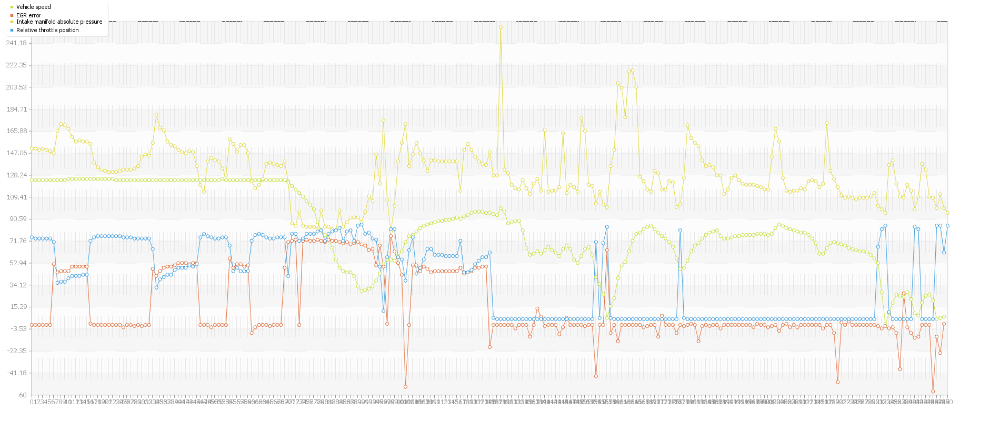
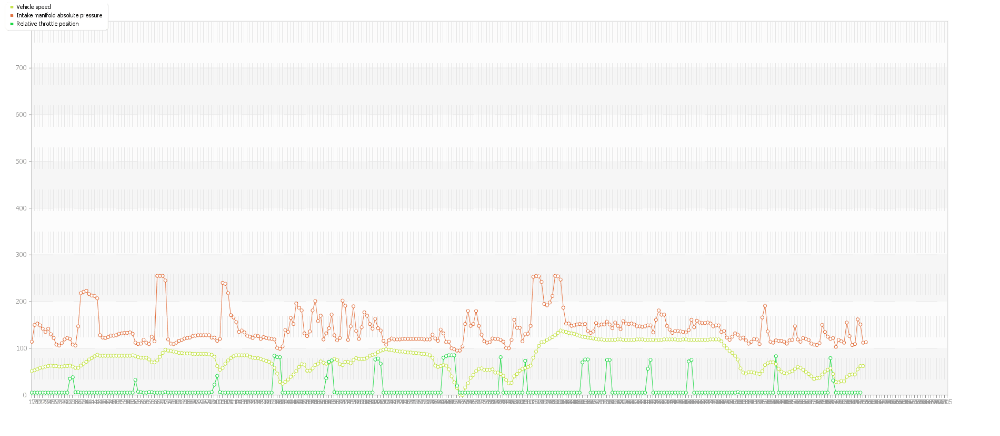
In attachement there is graph of typical situation: 128km/h on cruise control, and look what happens to throttle, egr and map sensor (probably becouse of throttle closing ?). Second file shows how often throttle is being closed while should not. (driving).
Will be grateful for any suggestions.
Kacper
After 5000km "check engine" lit. So I went to car dealer service and told them that car is acting strange and the icon lit. They said "too high voltage on throttle", replaced the throttle and deleted the error. If there is no more error codes service see no problem....
After that FC dropped just a little to 6.2-6.3 but still completly independent to speeding, ac usage, outside temperature etc.
After 14000km driven, FC dropped to 5.9-6.0 - just like that. I've bought OBD interface and some software to get readings and prove faults to car dealer service. And I've found some really strange values imho. My problem is that I cannot find any expected values over the internet, especially for diesel engines which vary from petrol one. For now my baseline is comparision to my friends diesel cars (renault clio and opel/vauxhall corsa) - it's not a perfect solution though.
So here is what I see and looks suspicious to me - maybe someone can confirm/decline my worries - please consider it for new car:
- my throttle open percentage is oposite to any other car/info I've found anywhere: it shows 85% @ idle, 5% when driving - it's like reporting how much close it is instead of how open - is it ok?
- when high FC occures throttle closes to 60-80% - why does diesel throttle closes when driving at all? Shouldn't it stay full open all the time above idle? this happens always when high FC
- when high FC occures EGR error reports from +80% to -80% values- it does not happens every time but quite often - should there be so high EGR ERRORS in new car at all?
- my Calculated Engine Load @ idle shows about 30-32% (warm engine, no ac, 840rpm) - why is so high? in other cars I checked it , it was about 20%!
In attachement there is graph of typical situation: 128km/h on cruise control, and look what happens to throttle, egr and map sensor (probably becouse of throttle closing ?). Second file shows how often throttle is being closed while should not. (driving).
Will be grateful for any suggestions.
Kacper
Please Log in or Create an account to join the conversation.
- Andy.MacFadyen
-
- Offline
- Moderator
-

Less
More
- Posts: 3357
- Thank you received: 1037
7 years 6 months ago - 7 years 6 months ago #24481
by Andy.MacFadyen
" We're trying to plug a hole in the universe, what are you doing ?. "
(Walter Bishop Fringe TV show)
Replied by Andy.MacFadyen on topic Brand new diesel car expected values
Although they look similar from the outside petrol engines and diesel engines work very differently. Diesels don't have a throttle the accelerator pedal is best thought of as speed control. Petrol engines are controlled by throttling the mass of air that goes into the cylinders, diesels are controlled by reducing or increasing the fuel going into the cylinders. With modern "drive by wire" systems the accelerator pedal is a fail safe design it has 2 control circuits A & B which work in opposite directions. Circuit A increases from around 0v upwards and circuit B decreases from around 5v downwards.
The EGR valve opens at idle and light loads to reduce NOx emmissions , exhaust gas recirculated through the egr do not pass through the MAF so distort any calculated load values . I suspect the short bursts of high fuel consumption are indeed some mode of DPF cleaning but ........ ?
OBDII live data lends to be less useful on diesel engines than petrol there is a a FIAT specific free/shareware program Multiecuscan that may be more useful.
Also diesels engines tend to show a bigger advantage in fuel consumption over petrol engines in town driving rather than at motorway speeds.
The EGR valve opens at idle and light loads to reduce NOx emmissions , exhaust gas recirculated through the egr do not pass through the MAF so distort any calculated load values . I suspect the short bursts of high fuel consumption are indeed some mode of DPF cleaning but ........ ?
OBDII live data lends to be less useful on diesel engines than petrol there is a a FIAT specific free/shareware program Multiecuscan that may be more useful.
Also diesels engines tend to show a bigger advantage in fuel consumption over petrol engines in town driving rather than at motorway speeds.
" We're trying to plug a hole in the universe, what are you doing ?. "
(Walter Bishop Fringe TV show)
Last edit: 7 years 6 months ago by Andy.MacFadyen.
Please Log in or Create an account to join the conversation.
- cac
-
Topic Author
- Offline
- New Member
-
Less
More
- Posts: 2
- Thank you received: 0
7 years 6 months ago #24490
by cac
Replied by cac on topic Brand new diesel car expected values
Actually new diesels mostly have throttle, but its purpose is slightly different: to stop the engine when you turn key to off position and to reduce trembling (sometimes it's called extinguishing flap). I'm aware they don't act like in petrol engine, and that hence my question: why does it close while driving? I get it that diesel acceleration basicly depends on fuel amount , but it expects "a lot of air" by default - if throttle closes , amount of air drops, right? Also MAP and MAF (got them both) report air and presure drops at that moments.
One thing to clear out: I didn't buy OBD becouse I have too much time to waste, but becouse I felt car is not accelerating smoothly , and FC is constant.
I have visited 4 different mechanic shops, posted on Fiat's forums (couple), and several tuning/diagostic forums , and I have to admit I'm really surprised: can't find single person who knows how diesel engine should act and what to expect from ECU readings There is so much great videos and informations about petrol, but diesel seems to be run by magic
One thing to clear out: I didn't buy OBD becouse I have too much time to waste, but becouse I felt car is not accelerating smoothly , and FC is constant.
I have visited 4 different mechanic shops, posted on Fiat's forums (couple), and several tuning/diagostic forums , and I have to admit I'm really surprised: can't find single person who knows how diesel engine should act and what to expect from ECU readings
There is so much great videos and informations about petrol, but diesel seems to be run by magic Please Log in or Create an account to join the conversation.
Time to create page: 0.275 seconds