
Help us help you. By posting the year, make, model and engine near the beginning of your help request, followed by the symptoms (no start, high idle, misfire etc.) Along with any prevalent Diagnostic Trouble Codes, aka DTCs, other forum members will be able to help you get to a solution more quickly and easily!
Alternator Not Charging
- 9910ae
-
 Topic Author
- Offline
- New Member
-

Less
More
- Posts: 3
- Thank you received: 1
7 years 7 months ago #23837
by 9910ae
Alternator Not Charging was created by 9910ae
My car is a 1999 Miata 1.8L.
I’m having a problem with my alternator not charging my battery. My battery light initially comes on when the key is turned to ON (normal), it comes back on after the car has been running about 30 seconds and stays lit. I checked the voltage at the battery with the car off (12.4V since it’s not charging) and car idling (12.0V). The belt tension for the alternator was initially low, so I tightened it within spec, still not charging.
I ended up testing for voltage at the B+ post and saw a range of 15-19V at idle and under load, and 12.4V when the car is off (B+ circuit is always hot). I tested the post itself, the nut, and the lead of the wire and they all read the same.
Next I performed a voltage drop test to ground, it tested good (0.02V). Then I tested for voltage drop on the positive side and it failed - 0.6 - 0.8V.
I checked the wiring harness from the alternator, under the car, and into the trunk and don’t see any signs of physical wear. No burnt fuses in that circuit either.
How could I possibly be seeing such a large voltage drop if the wiring harness doesn’t look like it’s being physically damaged? The car has no trouble starting or idling, the battery just won’t charge.
I’m having a problem with my alternator not charging my battery. My battery light initially comes on when the key is turned to ON (normal), it comes back on after the car has been running about 30 seconds and stays lit. I checked the voltage at the battery with the car off (12.4V since it’s not charging) and car idling (12.0V). The belt tension for the alternator was initially low, so I tightened it within spec, still not charging.
I ended up testing for voltage at the B+ post and saw a range of 15-19V at idle and under load, and 12.4V when the car is off (B+ circuit is always hot). I tested the post itself, the nut, and the lead of the wire and they all read the same.
Next I performed a voltage drop test to ground, it tested good (0.02V). Then I tested for voltage drop on the positive side and it failed - 0.6 - 0.8V.
I checked the wiring harness from the alternator, under the car, and into the trunk and don’t see any signs of physical wear. No burnt fuses in that circuit either.
How could I possibly be seeing such a large voltage drop if the wiring harness doesn’t look like it’s being physically damaged? The car has no trouble starting or idling, the battery just won’t charge.
Please Log in or Create an account to join the conversation.
- Paul P.
-

- Offline
- Platinum Member
-

Less
More
- Posts: 457
- Thank you received: 195
7 years 7 months ago #23843
by Paul P.
Never stop Learning.
Replied by Paul P. on topic Alternator Not Charging
15-19 volts is not good. The Field Coil on your Alt is controlled by the PCM through the Gray w Red Tracer wire. It is a Pulse Width Modulated signal, the PCM measures it as Duty Cycle. The more electrical load required from the Alternator the higher the PCM raises the Duty Cycle.
If you are able to measure the Duty Cycle with a DVOM capable of this, you should have 0% KOEO.
With the engine running this value should start increasing as you turn on more electrical loads.
Here, I am just trying to prove your PCM isn't commanding a 100% duty cycle.
Try unplugging the Gray/Red at the ALT and checking output voltage for a change.
As for the Positive side Volt drop, you can divide those numbers by 2, if you checked drop from BAT+ to ALT Output. You also dropped the starter POS at the same time if that's the case.
Heres a few diagrams for reference.
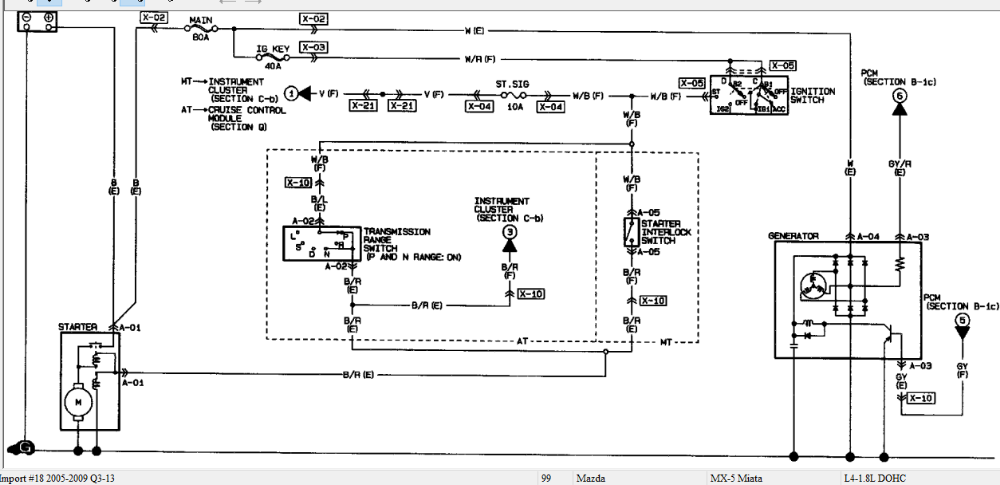
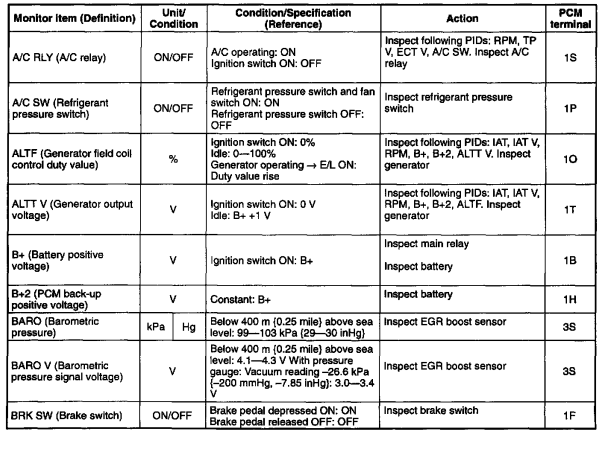
If you are able to measure the Duty Cycle with a DVOM capable of this, you should have 0% KOEO.
With the engine running this value should start increasing as you turn on more electrical loads.
Here, I am just trying to prove your PCM isn't commanding a 100% duty cycle.
Try unplugging the Gray/Red at the ALT and checking output voltage for a change.
As for the Positive side Volt drop, you can divide those numbers by 2, if you checked drop from BAT+ to ALT Output. You also dropped the starter POS at the same time if that's the case.
Heres a few diagrams for reference.
Never stop Learning.
The following user(s) said Thank You: Tyler, 9910ae
Please Log in or Create an account to join the conversation.
- 9910ae
-
Topic Author
- Offline
- New Member
-
Less
More
- Posts: 3
- Thank you received: 1
7 years 7 months ago - 7 years 7 months ago #23861
by 9910ae
Replied by 9910ae on topic Alternator Not Charging
One thing I forgot to mention, but when I initially tightened the alternator belt, it was charging the battery - I had measured 14.1V at the battery while the car idled. The car was idling smooth for several minutes and I shut it off for the night after checking the battery. When I started the car hours later to drive it, it shook violently at idle, fluctuating between about 850 RPM (normal) and 500 RPM, but otherwise drove normally. The battery light was still off as I took it around the block and back, then I parked it. I ended up trying different tensions on the belt - 120, 130, 140 ft lbs (spec is 110 - 158 ft lbs), but the battery wouldn't see above 12.0V with any of these, but the car would start and idle perfectly. That's when I started checking the BAT+ post and saw the 15-19V range.
My DMM is not capable of checking duty cycle, so I will need to get one that can. If I have a voltage drop on the positive side of the circuit, no charge at the battery, and high voltage coming from the BAT+, wouldn't the PCM command a 100% duty cycle until it sees the proper voltage from the battery? Are you suggesting to check this because if PCM is not actually commanding a 100% duty cycle, then the high output voltage would be a sign of an internal problem in my alternator? I don't mean to sound disrespectful, I'm just wondering if these are likely scenarios.
I did take my inspection camera along the length of the harness, from alternator -> starter -> fuse box -> under car -> into the trunk and couldn't see any signs of wear or damage to the harness anywhere.
My DMM is not capable of checking duty cycle, so I will need to get one that can. If I have a voltage drop on the positive side of the circuit, no charge at the battery, and high voltage coming from the BAT+, wouldn't the PCM command a 100% duty cycle until it sees the proper voltage from the battery? Are you suggesting to check this because if PCM is not actually commanding a 100% duty cycle, then the high output voltage would be a sign of an internal problem in my alternator? I don't mean to sound disrespectful, I'm just wondering if these are likely scenarios.
I did take my inspection camera along the length of the harness, from alternator -> starter -> fuse box -> under car -> into the trunk and couldn't see any signs of wear or damage to the harness anywhere.
Last edit: 7 years 7 months ago by 9910ae.
Please Log in or Create an account to join the conversation.
- Paul P.
-
- Offline
- Platinum Member
-
Less
More
- Posts: 457
- Thank you received: 195
7 years 7 months ago #23862
by Paul P.
Never stop Learning.
Replied by Paul P. on topic Alternator Not Charging
Granted, the voltage drop is a little high here.
My first concern would be to make sure the PCM isn't commanding a high duty cycle at idle with very little load.Then as load is increased at idle the duty cycle should rise. I want to verify the PCM is functioning properly before condemning the Alternator.
If the PCM is OK, then I would suspect the Alternator.
Also, you can try putting a booster cable (known good) from Alternator output to B+ and do the duty cycle checks, AND recheck your output voltage to see if it improves, if it does improve and holds steady at low and high load ranges, you can suspect your positive side wiring at this point, which I have yet to believe this is an issue.
As for the alternator, with the belt off, how does it sound spinning it by hand? Is there any wiggle in the pulley? AND with that high of voltage, do any of the lights seem a little brighter than normal?
If you have access to a code reader, report if you have any DTC's stored.
As for the 15-19 volts, that is a state of over-charging, excessive Alternator output. This is usually caused by a failure of the internal voltage regulator in the Alternator.
No worries about disrespect, it is respectful to ask questions. All questions are good questions!
Are you suggesting to check this because if PCM is not actually commanding a 100% duty cycle, then the high output voltage would be a sign of an internal problem in my alternator?
My first concern would be to make sure the PCM isn't commanding a high duty cycle at idle with very little load.Then as load is increased at idle the duty cycle should rise. I want to verify the PCM is functioning properly before condemning the Alternator.
If the PCM is OK, then I would suspect the Alternator.
Also, you can try putting a booster cable (known good) from Alternator output to B+ and do the duty cycle checks, AND recheck your output voltage to see if it improves, if it does improve and holds steady at low and high load ranges, you can suspect your positive side wiring at this point, which I have yet to believe this is an issue.
As for the alternator, with the belt off, how does it sound spinning it by hand? Is there any wiggle in the pulley? AND with that high of voltage, do any of the lights seem a little brighter than normal?
If you have access to a code reader, report if you have any DTC's stored.
As for the 15-19 volts, that is a state of over-charging, excessive Alternator output. This is usually caused by a failure of the internal voltage regulator in the Alternator.
No worries about disrespect, it is respectful to ask questions. All questions are good questions!
Never stop Learning.
The following user(s) said Thank You: 9910ae
Please Log in or Create an account to join the conversation.
- 9910ae
-
Topic Author
- Offline
- New Member
-
Less
More
- Posts: 3
- Thank you received: 1
7 years 6 months ago - 7 years 6 months ago #23996
by 9910ae
Replied by 9910ae on topic Alternator Not Charging
SOLVED!
I don't mean to bump an old thread, but I've solved my issue: it was the alternator.
Despite the engine being grounded, I got bad readings because I put my negative test lead on a valve cover bolt. When I decided to attach my probe to my test lead on the engine/chassis ground, I got a correct reading of 11.84V at the B+ wire at idle. I also tested my D and P lines from the PCM - with key on, engine off, you can get good readings and match what the Mazda service manual requires - under 0V, and near 0V. My readings were strange from these when I tried to measure them with the car idling and the plug disconnected - any other Miata owners will need to test them with a test lead while they're plugged in and the engine idling to get what the Mazda service manual says you should be seeing voltage-wise.
I figured my positive side wiring MUST be okay given that disconnecting my B+ wire and measuring it yielded the exact same voltage as my battery terminals. When checking resistance across my negative and positive line sides, they came up identical - indicating no opens or high resisitance - and my visual check of the wiring indicated no external wear or damage.
With this knowledge, I replaced my alternator with a remanufactured unit. Voltage reading at B+ was 14.7V or so with the car idling. Battery reading was identical. The new alternator charges appropriately under increased load and my battery light has not come back. Belt tension is also within spec. Car starts as normal, idles smoothly, and pulls strong up to redline. Thanks for everyone's help!
EDIT: I checked my pulley bearing against the new unit when I removed my factory alternator - there was ever-so-slightly more resistance to spinning by hand than the reman unit, but the bearing is definitely still good and does not create any strange noises. I also had checked for codes using my bluetooth OBD-II reader, and got a "No Codes" result - consistent with my CORRECT voltage reading. If the alternator was actually outputting 15-19V it should have been throwing a P1634 code, which it wasn't, thus making troubleshooting this very confusing at first.
I don't mean to bump an old thread, but I've solved my issue: it was the alternator.
Despite the engine being grounded, I got bad readings because I put my negative test lead on a valve cover bolt. When I decided to attach my probe to my test lead on the engine/chassis ground, I got a correct reading of 11.84V at the B+ wire at idle. I also tested my D and P lines from the PCM - with key on, engine off, you can get good readings and match what the Mazda service manual requires - under 0V, and near 0V. My readings were strange from these when I tried to measure them with the car idling and the plug disconnected - any other Miata owners will need to test them with a test lead while they're plugged in and the engine idling to get what the Mazda service manual says you should be seeing voltage-wise.
I figured my positive side wiring MUST be okay given that disconnecting my B+ wire and measuring it yielded the exact same voltage as my battery terminals. When checking resistance across my negative and positive line sides, they came up identical - indicating no opens or high resisitance - and my visual check of the wiring indicated no external wear or damage.
With this knowledge, I replaced my alternator with a remanufactured unit. Voltage reading at B+ was 14.7V or so with the car idling. Battery reading was identical. The new alternator charges appropriately under increased load and my battery light has not come back. Belt tension is also within spec. Car starts as normal, idles smoothly, and pulls strong up to redline. Thanks for everyone's help!
EDIT: I checked my pulley bearing against the new unit when I removed my factory alternator - there was ever-so-slightly more resistance to spinning by hand than the reman unit, but the bearing is definitely still good and does not create any strange noises. I also had checked for codes using my bluetooth OBD-II reader, and got a "No Codes" result - consistent with my CORRECT voltage reading. If the alternator was actually outputting 15-19V it should have been throwing a P1634 code, which it wasn't, thus making troubleshooting this very confusing at first.
Last edit: 7 years 6 months ago by 9910ae.
The following user(s) said Thank You: Paul P.
Please Log in or Create an account to join the conversation.
Time to create page: 0.308 seconds