
'08 Ram 2500 6.7 No Comm to O2 Module U011A
- ephotrod
-
 Topic Author
- Offline
- New Member
-

- Posts: 14
- Thank you received: 16
Thank you I'll get a couple more videos (so i can learn) before we replace the module and one after. I'm doing alot of this to learn, I never went to a formal school or was taught how to work on cars, this is a great opportunity for me. Your and Pauls efforts are greatly appreciated. I've bought both books and have a years subscription to his channel, but guidance like your giving me is worth more than it all. Thank you.
Josh
Please Log in or Create an account to join the conversation.
- Tyler
-
- Offline
- Moderator
-

- Full time HACK since 2012
- Posts: 6063
- Thank you received: 1531
Speaking of, could I talk you into doing some more experimenting? I'd love to have voltage readings on the six NOx sensor wires at the sensing module
 Looking at the pin designations on the wiring diagram makes me think it's wired like an air/fuel ratio sensor, but I'm not certain. No worries at all if you don't have the opportunity! Just trying to expand my knowledge of these systems.
 Please Log in or Create an account to join the conversation.
- ephotrod
-
Topic Author
- Offline
- New Member
-
- Posts: 14
- Thank you received: 16
Please Log in or Create an account to join the conversation.
- Tyler
-
- Offline
- Moderator
-
- Full time HACK since 2012
- Posts: 6063
- Thank you received: 1531
No need to video the sensor voltages, just static measurements will work perfectly.
Please Log in or Create an account to join the conversation.
- Tyler
-
- Offline
- Moderator
-
- Full time HACK since 2012
- Posts: 6063
- Thank you received: 1531
Please Log in or Create an account to join the conversation.
- ephotrod
-
Topic Author
- Offline
- New Member
-
- Posts: 14
- Thank you received: 16
Please Log in or Create an account to join the conversation.
- Tyler
-
- Offline
- Moderator
-
- Full time HACK since 2012
- Posts: 6063
- Thank you received: 1531
Also, how many wires total are there at this module? The BBB Industries diagram I posted earlier showed 10, with one sensor connected. But the Mitchell diagram I found showed 16 wires, with two sensors connected.
IF the diagram I posted earlier corresponds to your truck, then I'm looking for voltage readings on pins 1, 6, 7, 14, 15, and 16. I'm gonna take a shot in the dark and say:
Pin 1 + 16: Pulsed power and steady ground
Pin 14: 2.5V steady
Pin 7: 3V steady
Pin 6: 2.5V, varying
Pin 15: same as pin 6
Could be WAY off :lol:
Please Log in or Create an account to join the conversation.
- ephotrod
-
Topic Author
- Offline
- New Member
-
- Posts: 14
- Thank you received: 16
Please Log in or Create an account to join the conversation.
- Chriscoy
-

- Offline
- Junior Member
-

- Heavy duty truck technician / foreman/ parts guy/
- Posts: 29
- Thank you received: 6
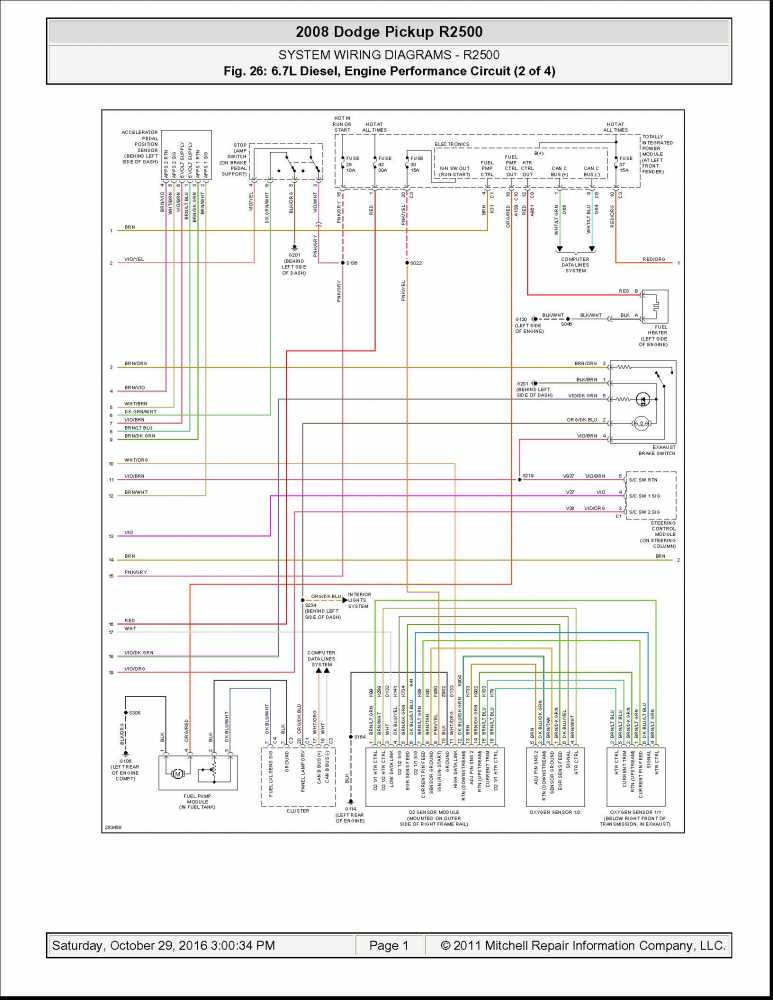
If you have clean data square waves at the module it's probably a failed NOx sensor.
Prior to replacing it check for TSB's, If you have the Engine Serial Number I can try and check QuickServe for anything on cummins side.
Changing parts is easy, Troubleshooting is an art
Please Log in or Create an account to join the conversation.
- ephotrod
-
Topic Author
- Offline
- New Member
-
- Posts: 14
- Thank you received: 16
Pin 1: 12.31 volts
Pin 2: 12.31 volts
Pin 3: 2.95 volts
Pin 4: 2.94 volts
Pin 5: 2.86 volts
Pin 6: 2.94 volts
Pin 7: 2.84 volts
Pin 8: 12.35 volts
Pin 9: 12.35 volts
Pin 10: .69 volts
Pin 11: .68 volts
Pin 12: .68 volts
Pin 13: 2.52 volts
Pin 14: 2.52 volts
Pin 15: 2.86 volts
Pin 16: 12.30 volts
I don't have clean data square waves based on either pin 3 (white) the low data link or pin 11(white and orange) high data link.
Please Log in or Create an account to join the conversation.
- ephotrod
-
Topic Author
- Offline
- New Member
-
- Posts: 14
- Thank you received: 16
Please Log in or Create an account to join the conversation.
- ephotrod
-
Topic Author
- Offline
- New Member
-
- Posts: 14
- Thank you received: 16
Please Log in or Create an account to join the conversation.
- Noah
-
- Offline
- Moderator
-
- Give code definitions with numbers!
- Posts: 4957
- Thank you received: 1111
Forgive me if I'm missing something, but there's not a good ground on any of those pins. I'd think at least one would be (much) lower than half a volt.ephotrod wrote: The following are all my readings based on the on demand diagram. A vantage Pro was used on a 20 volt scale 5 ms time base. There are 16 pins all together.
Pin 1: 12.31 volts
Pin 2: 12.31 volts
Pin 3: 2.95 volts
Pin 4: 2.94 volts
Pin 5: 2.86 volts
Pin 6: 2.94 volts
Pin 7: 2.84 volts
Pin 8: 12.35 volts
Pin 9: 12.35 volts
Pin 10: .69 volts
Pin 11: .68 volts
Pin 12: .68 volts
Pin 13: 2.52 volts
Pin 14: 2.52 volts
Pin 15: 2.86 volts
Pin 16: 12.30 volts
I don't have clean data square waves based on either pin 3 (white) the low data link or pin 11(white and orange) high data link.
The diagram looks bad on my phone, gonna have to fire up the PC, but that's my initial impression.
"Ground cannot be checked with a 10mm socket"
Please Log in or Create an account to join the conversation.
- Tyler
-
- Offline
- Moderator
-
- Full time HACK since 2012
- Posts: 6063
- Thank you received: 1531
ephotrod wrote: The following are all my readings based on the on demand diagram. A vantage Pro was used on a 20 volt scale 5 ms time base. There are 16 pins all together.
Pin 1: 12.31 volts
...
Yay! :woohoo: Thanks a ton, sir! This is exactly what I was looking for.
Forgive me if I'm missing something, but there's not a good ground on any of those pins. I'd think at least one would be (much) lower than half a volt.
The diagram looks bad on my phone, gonna have to fire up the PC, but that's my initial impression.
Floating ground
 Usually 2.5V, but some Fords use 3.6V (for whatever reason
  ). That's why pins 13 and 14 show 2.52V.
The predictions I made for those pin voltages were hit and miss. I had this pegged for a power-side switched heater, but I think it's actually ground-side switched. Oh well

61 ohms sounds correct. The ECM has a termination resistor and the variable geometry turbo actuator has the second.
It does? :huh: Looking at the diagram again, and it doesn't show the turbo involved:
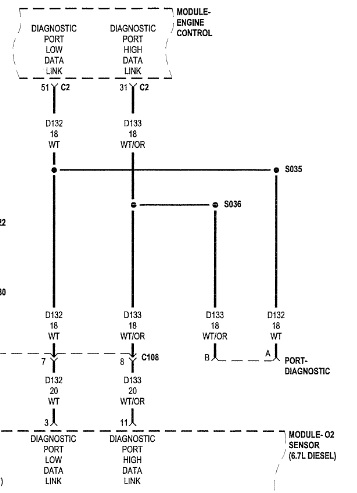
Could be the diagram is wrong?
Please Log in or Create an account to join the conversation.
- Noah
-
- Offline
- Moderator
-
- Give code definitions with numbers!
- Posts: 4957
- Thank you received: 1111
"Ground cannot be checked with a 10mm socket"
Please Log in or Create an account to join the conversation.
- Tyler
-
- Offline
- Moderator
-
- Full time HACK since 2012
- Posts: 6063
- Thank you received: 1531
Noah wrote: The module itself uses a floating ground? I thought that was a signal circuit strategy?
Sorry, I coulda been more specific there :blush: The sensor circuits use a floating ground. Actually, I see what you mean now... Pin 10 is the module ground, with .68V :blink: I didn't look too closely at that one, 'cause ephotrod said he checked module power and ground in the first post.
Maybe it's time to revisit the module ground? :huh:
Please Log in or Create an account to join the conversation.
- Noah
-
- Offline
- Moderator
-
- Give code definitions with numbers!
- Posts: 4957
- Thank you received: 1111
"Ground cannot be checked with a 10mm socket"
Please Log in or Create an account to join the conversation.
- ephotrod
-
Topic Author
- Offline
- New Member
-
- Posts: 14
- Thank you received: 16
Please Log in or Create an account to join the conversation.
- Tyler
-
- Offline
- Moderator
-
- Full time HACK since 2012
- Posts: 6063
- Thank you received: 1531
ephotrod wrote: Would it be alright to use a jumper wire back probe on pin 10 to a chasis ground and see if I have signal then? WHat would be the right way to go about it?
That would work! You could even keep your meter hooked up to the same backprobe and watch the voltage drop down when you add the jumper in. You could also use a test light connected to B+ and touch on the same pin, looking for the light to burn bright. Key on, either way.
If you end up adding a ground, just make sure that the ground your adding is a good ground itself. Then, you can clear the codes and see if anything comes back. If the code doesn't return, then you've found the problem

Please Log in or Create an account to join the conversation.
- Noah
-
- Offline
- Moderator
-
- Give code definitions with numbers!
- Posts: 4957
- Thank you received: 1111
"Ground cannot be checked with a 10mm socket"
Please Log in or Create an account to join the conversation.