
Help us help you. By posting the year, make, model and engine near the beginning of your help request, followed by the symptoms (no start, high idle, misfire etc.) Along with any prevalent Diagnostic Trouble Codes, aka DTCs, other forum members will be able to help you get to a solution more quickly and easily!
98 Chevy Blazer Back-Up Lamp Circuit [FIXED]
- rockp2
-
 Topic Author
- Offline
- Elite Member
-

Less
More
- Posts: 167
- Thank you received: 40
8 years 4 months ago - 8 years 4 months ago #15965
by rockp2
98 Chevy Blazer Back-Up Lamp Circuit [FIXED] was created by rockp2
4.3L VIN ‘W’ ZR2 Manual Trans 2-Door Utility. Guys and Gals, I am completely stumped and seeking guidance and direction. My 25 amp fuse for my Blazer’s back up lights blew. Have had problems with the back-up lights previously. To shorten the story, the switch is good and the lights from the switch to the lamps work fine as I power them up from the switch harness side (disconnected) with a Power Probe. Here is my stumped spot. With the switch disconnected, blown fuse in place (B/U LAMPS), KOEO, I am reading 9.25 volts at the switch harness side power wire (wire that goes from Underhood Fuse Block to switch). I don’t understand how I can get any voltage with the fuse blown? It is completely blown and there is no continuity between the two blades. I have attached both an image of the circuit from the TSM as well as a map of the circuit from B+ to B-. Other symptoms/diagnosis (all with switch disconnected measuring at switch harness side, blown fuse in place (B/U Lamps) KOEO (unless otherwise noted)):
1. When fuse is completely removed, showing 0v (as it should) on feed wire.
2. New fuse shows battery voltage (as it should).
3. With KEY OFF, ghost voltage (as it should).
4. TSM troubleshooting states with new fuse and KEY OFF, switch disconnected, test for continuity from power side wire to ground. There is continuity (very low). TSM says repair short in circuit 839 (the wire from the switch to the Underhood Fuse Block). I can find no short and my PP Short Finder indicates “Open” (as it should be…correct?).
5. Since both wires from the switch ride alongside each other between the fuse block and the switch, I removed the VEH B/U and TRL B/U fuses to break the circuit after the switch to insure there was not power bleeding from anywhere in that circuit (or outside of it) into the problem wire due to a short. Still got the 9.25v reading.
Have I narrowed it down to either a short to power in either the Underhood Fuse Block itself or the ignition switch? What would be the best way for me to determine which one it is…if I am on the right track? BIG QUESTION: Would it be safe for my ECM to use my Fluke Multi-meter in CONTINUITY MODE (obviously NOT having the lead in the 10a jumper wire jack) to check for a short to power by removing the blown fuse, holding one lead on the fuse blade location that goes to switch (switch disconnected) then touching other locations within Underhood Fuse Block to see if I find continuity where it shouldn’t be? This would be with KOEO since I’ve already determined I am only getting that 9.25v in the KOEO mode.
Any help or guidance greatly appreciated. What do I do next, or what am I missing. I have Paul’s book and am a premium member so if there is a page or a specific video I should look at, please reference. Thanks much!
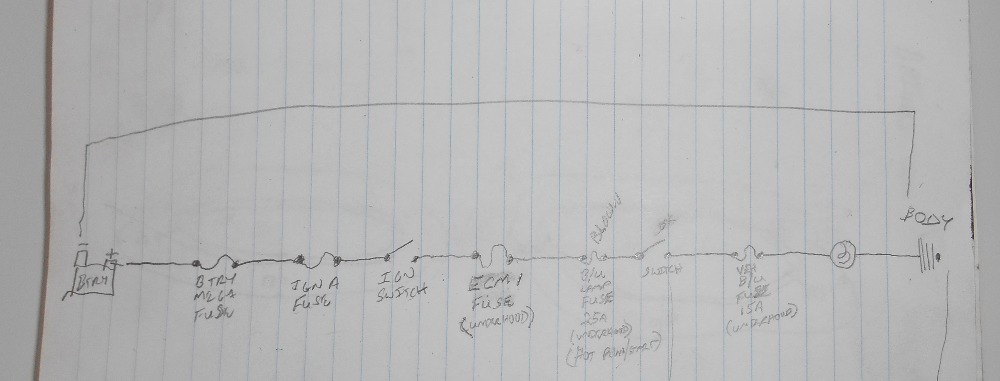
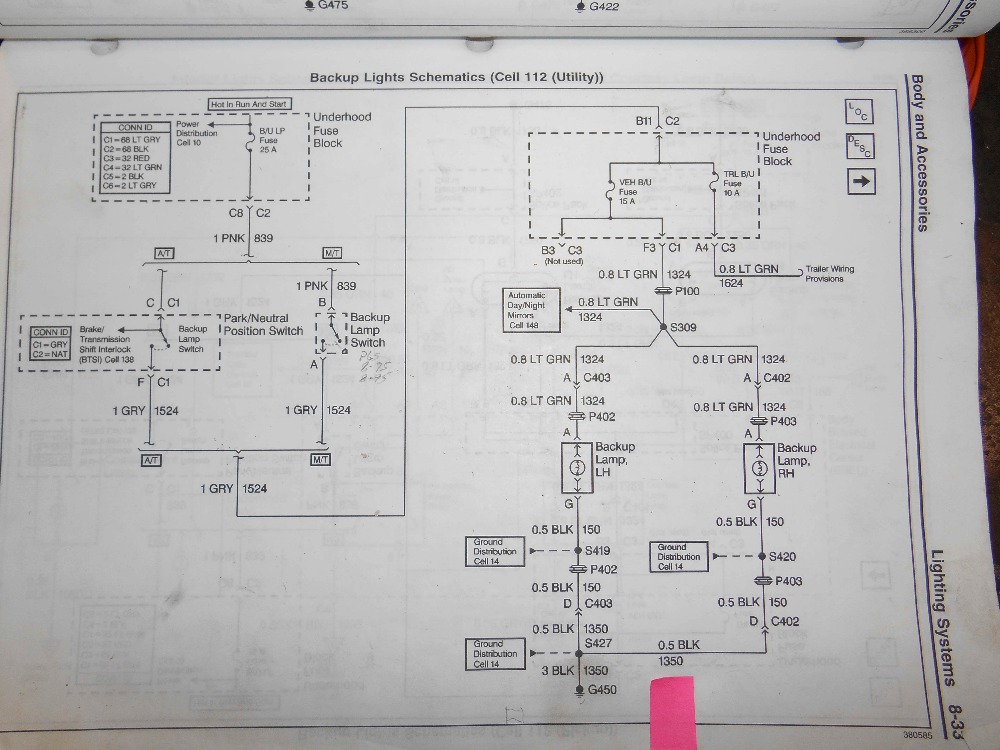
1. When fuse is completely removed, showing 0v (as it should) on feed wire.
2. New fuse shows battery voltage (as it should).
3. With KEY OFF, ghost voltage (as it should).
4. TSM troubleshooting states with new fuse and KEY OFF, switch disconnected, test for continuity from power side wire to ground. There is continuity (very low). TSM says repair short in circuit 839 (the wire from the switch to the Underhood Fuse Block). I can find no short and my PP Short Finder indicates “Open” (as it should be…correct?).
5. Since both wires from the switch ride alongside each other between the fuse block and the switch, I removed the VEH B/U and TRL B/U fuses to break the circuit after the switch to insure there was not power bleeding from anywhere in that circuit (or outside of it) into the problem wire due to a short. Still got the 9.25v reading.
Have I narrowed it down to either a short to power in either the Underhood Fuse Block itself or the ignition switch? What would be the best way for me to determine which one it is…if I am on the right track? BIG QUESTION: Would it be safe for my ECM to use my Fluke Multi-meter in CONTINUITY MODE (obviously NOT having the lead in the 10a jumper wire jack) to check for a short to power by removing the blown fuse, holding one lead on the fuse blade location that goes to switch (switch disconnected) then touching other locations within Underhood Fuse Block to see if I find continuity where it shouldn’t be? This would be with KOEO since I’ve already determined I am only getting that 9.25v in the KOEO mode.
Any help or guidance greatly appreciated. What do I do next, or what am I missing. I have Paul’s book and am a premium member so if there is a page or a specific video I should look at, please reference. Thanks much!
Last edit: 8 years 4 months ago by rockp2. Reason: FIXED
Please Log in or Create an account to join the conversation.
- rockp2
-
Topic Author
- Offline
- Elite Member
-
Less
More
- Posts: 167
- Thank you received: 40
8 years 4 months ago #15969
by rockp2
Replied by rockp2 on topic 98 Chevy Blazer Back-Up Lamp Circuit [FIXED]
Well I had one hell of a long, long, long learning moment. Apparently the reason I was showing the 9.25 voltage through the feed wire was because the blown fuse was one of those easyID fuses. The diode wasn't lit, and as I stated there was no continuity between the two blades, but I put a purposely popped normal fuse in the old fuse's place and...wala. No more voltage. How it had any voltage going down that wire while at the same time not showing continuity is beyond me. As far as what caused it to pop in the first place, I was tracing other loads that shared the ECM 1 fuse and found a heater ground wire that had broke off the outside of one of my O2 sensors. I could see what appeared (to me) to be light arcing in between the wire and the sensor case so while I'm not going to bet the house on it...or even a dollar, I'm going to silver solder the wire back to the sensor and see what happens. I'm sure you pros would have figured the easyID thing out in about 30 seconds flat...well now I know too  Signed -Still Learning
Signed -Still Learning Please Log in or Create an account to join the conversation.
Time to create page: 0.337 seconds