
compression testing variables
- cheryl hartkorn
-
 Topic Author
- Offline
- Platinum Member
-

- Posts: 694
- Thank you received: 130
Please Log in or Create an account to join the conversation.
- Ben
-
- Offline
- Platinum Member
-
- Posts: 1098
- Thank you received: 215
Sent from my SM-N920P using Tapatalk
Please Log in or Create an account to join the conversation.
- Ben
-
- Offline
- Platinum Member
-
- Posts: 1098
- Thank you received: 215
Sent from my SM-N920P using Tapatalk
Please Log in or Create an account to join the conversation.
- Andy.MacFadyen
-

- Offline
- Moderator
-

- Posts: 3357
- Thank you received: 1037
A First-Look pressure pulse test on the exhaust or inlet should show something but interpreting First-Look tests to diagnose a particular fault isn;t easy.
" We're trying to plug a hole in the universe, what are you doing ?. "
(Walter Bishop Fringe TV show)
Please Log in or Create an account to join the conversation.
- cheryl hartkorn
-
Topic Author
- Offline
- Platinum Member
-
- Posts: 694
- Thank you received: 130
Please Log in or Create an account to join the conversation.
- bruce.oliver
-

- Offline
- Elite Member
-

- Posts: 318
- Thank you received: 88
Please Log in or Create an account to join the conversation.
- cheryl hartkorn
-
Topic Author
- Offline
- Platinum Member
-
- Posts: 694
- Thank you received: 130
Please Log in or Create an account to join the conversation.
- bruce.oliver
-
- Offline
- Elite Member
-
- Posts: 318
- Thank you received: 88
Please Log in or Create an account to join the conversation.
- Andy.MacFadyen
-
- Offline
- Moderator
-
- Posts: 3357
- Thank you received: 1037
" We're trying to plug a hole in the universe, what are you doing ?. "
(Walter Bishop Fringe TV show)
Please Log in or Create an account to join the conversation.
- Andy.MacFadyen
-
- Offline
- Moderator
-
- Posts: 3357
- Thank you received: 1037
cheryl hartkorn wrote: i could tell there was an issue during cranking. at the time i dint know if it was out of time or if it was a compression issue at the time. vacuum gauge was super steady at idle no fluttering or anything i was taking vacuum at the brake booster
I never really learned the skill of using a vacuum gauge as it was not useful on the engines I learned on which were mainly 4 cylinder twin carb.
" We're trying to plug a hole in the universe, what are you doing ?. "
(Walter Bishop Fringe TV show)
Please Log in or Create an account to join the conversation.
- Tyler
-
- Offline
- Moderator
-
- Full time HACK since 2012
- Posts: 6129
- Thank you received: 1545
I'm really surprised your vacuum gauge was steady, Cheryl. :huh: It's gotta be dumping 100+ PSI into the intake when the intake valve opens... Why doesn't the vacuum gauge notice?
Please Log in or Create an account to join the conversation.
- Andy.MacFadyen
-
- Offline
- Moderator
-
- Posts: 3357
- Thank you received: 1037
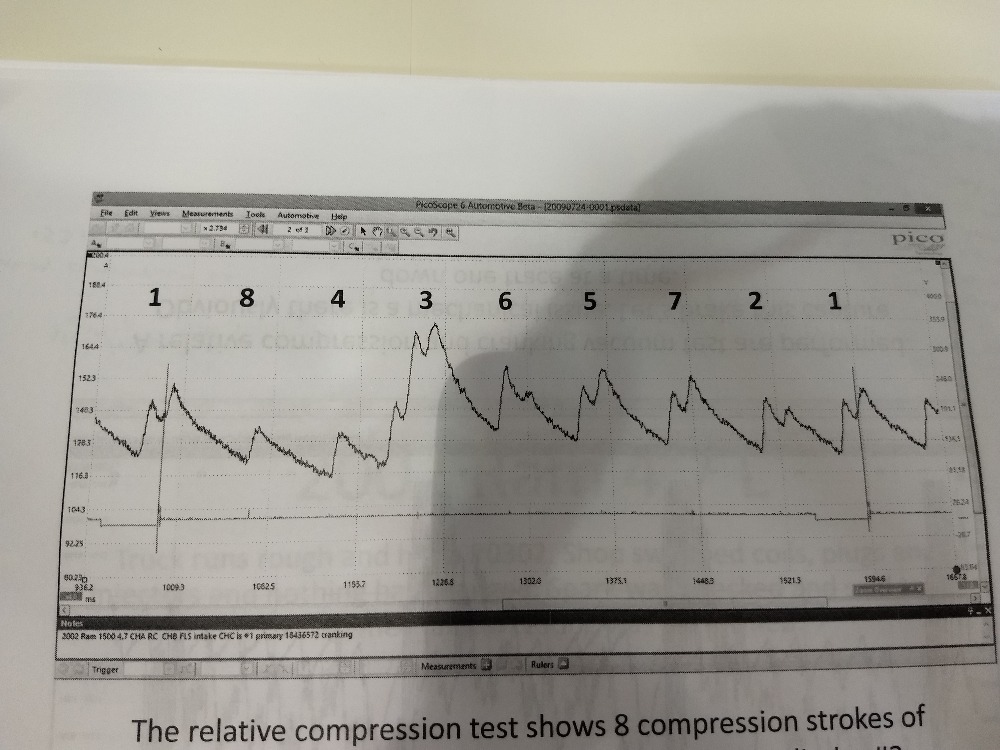
Tyler wrote: I've seen the same thing as Bruce on a relative compression waveform. This is my go-to test when I think a rocker arm fell off a 3.7/4.7 engine. I used to go in-cylinder to prove it, now I just sell valve cover labor. :lol: Nice job going with your gut and the cranking sound.
I'm really surprised your vacuum gauge was steady, Cheryl. :huh: It's gotta be dumping 100+ PSI into the intake when the intake valve opens... Why doesn't the vacuum gauge notice?
I wonder if the brake booster vacuum take off had the one-way check valve built in atthe manifold end ? butsurely even then I would have expected some pulsing on the gauge.
" We're trying to plug a hole in the universe, what are you doing ?. "
(Walter Bishop Fringe TV show)
Please Log in or Create an account to join the conversation.